Synthetic Minds | You Stopped Being the Customer and Became the Signal

Synthetic Minds | You Stopped Being the Customer and Became the Signal
The Synthetic Minds newsletter offers short daily insights to get you thinking. If you enjoy it, please forward. All signals are powered by Futurwise. If you need more insights, subscribe to Futurwise and get 25% off for the first three months!
I have just launched the Intelligence Age Scorecard! It will help you understand how ready your organization is for the Intelligence Age.
Today’s topic: Spatial Intelligence
Who Owns the Signal When You're Read?
Two of the companies that profit most from your attention have shown, side by side, how they plan to read your mind. One decoding brain activity without any surgery, the other threading electrodes through the membrane around your brain.
Read these as gadget news and they are curiosities. Read them together and the spatial platform stops being a device you buy and becomes a signal that platforms capture.
Meta has taught software to read typed sentences straight from brain activity, no implant required, at 61 percent word accuracy, then released the code for anyone to use.
Neuralink has placed its threads through the brain's tough outer membrane without cutting it away, removing the most delicate step and calling it a path to scale.
The specialist press covering both names the real destination out loud: not only paralysis patients, but an eventual consumer product.
One layer out, NVIDIA has made Omniverse, its simulator of the physical world, free for production, scrapping a license that ran $4,500 per chip each year.
That simulator trains the robots and cars that must reason about the real world. Handing it out removes the reason to build on anything else.
That's the hardware story. Here is the signal.
For three years the spatial pitch was about the room. How to wrap floating screens around you. That pitch has moved. The frontier is no longer the space in front of your eyes; it is the signal behind them.
Look at who is holding the tools. The firms racing to decode the brain are the same firms whose entire business model is monetizing what you look at.
One bets that reading from outside the skull, helped by AI, will win; the other bets on bandwidth and makes the surgery repeatable. Both are giving their methods away or engineering them toward scale, because the prize is not the device.
The same logic runs one layer out. The company that sells the chips behind every AI model has made its world-simulator free. Not from generosity, but because the value sits in the silicon it runs on and the model of reality it produces. Give away the reader; keep the signal.
Here is what no one is pricing. When the reading tool costs nothing, the product is no longer the headset or the glasses.
The product is you. Your surroundings, your movements, your words before you speak them, turned into data a platform keeps. The device that stopped showing you and started recording you was the near edge of this.
The brain is the far one, and no consent framework governs neural data held by an advertising company.
The question for you is not which device to use or to standardize on. It is who owns the signal once you become the thing being read.
The Intelligence Age Scorecard
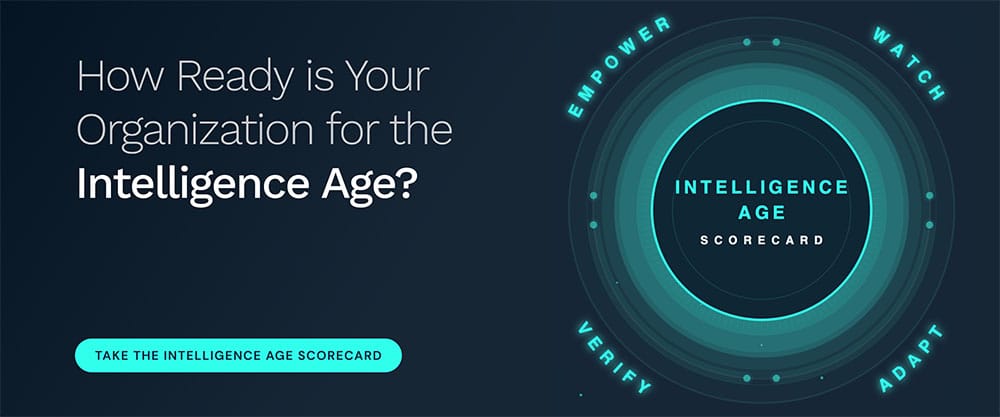
The tools that read your world and your people are being given away, and the value has quietly moved to whoever keeps the decoded signal. That is a WAVE question (Watch, Adapt, Verify, Empower): are you still watching which headset to pick, or already adapting to a market where the platform captures the signal, not the sale?
Benchmark your readiness for the next two quarters with the Intelligence Age Scorecard. Or read the public Intelligence Age Scorecard of Accenture, IBM, Visa, Qantas, Woolworths, Telstra or Commonwealth Bank first.
If this newsletter was forwarded to you, you can sign up here.
Thank you.
Mark
Frequently asked questions
How does Meta's brain-reading technology work?
Meta has taught software to read typed sentences straight from brain activity without requiring any surgical implant, achieving 61 percent word accuracy. The company then released the underlying code for anyone to use, moving the technology from research curiosity toward wider accessibility and eventual consumer application.
Link to this questionHow is Neuralink's approach different from Meta's?
Neuralink places its threads through the brain's tough outer membrane without cutting it away, removing what had been the most delicate surgical step. This is described as a path to scale, betting on bandwidth and making the surgery repeatable, in contrast to Meta's non-surgical, AI-assisted approach to reading brain activity from outside the skull.
Link to this questionWhy did NVIDIA make Omniverse free?
NVIDIA made Omniverse, its simulator of the physical world used to train robots and cars to reason about reality, free for production, scrapping a license that previously cost $4,500 per chip each year. This was not generosity but strategy, since the real value lies in the silicon Omniverse runs on and the model of reality it produces, removing incentives to build on competing platforms.
Link to this questionWhy does giving away brain-reading tools for free matter?
When the reading tool costs nothing, the actual product becomes the person being read: their surroundings, movements, and words before they even speak them, turned into data a platform keeps. No consent framework currently governs neural data held by an advertising company, meaning the real question becomes who owns the signal once someone becomes the thing being read, rather than which device to choose.
Link to this question
Dr. Mark van Rijmenam
Dr. Mark van Rijmenam is The Digital Speaker, a world-leading futurist and global AI keynote speaker who helps leaders decide what AI, and the technologies that follow it, mean for their business. He speaks to leadership teams at their retreats and to conference audiences worldwide, and his WAVE framework gives them a way of deciding that they keep using long after he has left the room. His Intelligence Age Scorecard measures how ready an organization is across the four WAVE pillars.
He holds a PhD from the University of Technology Sydney, is a Certified Speaking Professional and Global Speaking Fellow, and ranks among the world’s top futurists on the Global Gurus list (#1 in 2025, #3 in 2026). Salesforce named him one of its 16 leading AI voices. He has written six books, most recently Now What? How to Ride the Tsunami of Change, writes the Synthetic Minds newsletter on Substack, and founded Futurwise. Talk to his digital twin on WhatsApp: +1 (830) 463-6967.