Synthetic Minds | AI Labs Are Rebuilding Science on Private AI
Synthetic Minds | AI Labs Are Rebuilding Science on Private AI
The Synthetic Minds newsletter offers short daily insights to get you thinking. If you enjoy it, please forward. All signals are powered by Futurwise. If you need more insights, subscribe to Futurwise and get 25% off for the first three months!
I have just launched the Intelligence Age Scorecard! It will help you understand how ready your organization is for the Intelligence Age.
Today’s topic: AI & Automation
Who Owns Discovery When AI Runs Science
A software company with no laboratory has started designing its own medicines, and a national research institute has declared that the method of science itself is being rewritten.
Read the announcements as products and you miss it. Together they show AI moving from a tool scientists use to the layer discovery runs on.
Anthropic has launched a research platform that folds sixty scientific databases into one workspace, and has begun designing its own drugs for diseases the industry abandoned.
In Britain, the lab whose protein-folding AI won a Nobel Prize has moved from prediction to design; its spin-out is entering human trials with AI-designed cancer drugs.
OpenAI has opened its own life-sciences model to labs worldwide, with Novo Nordisk, Amgen and Moderna inside.
China's labs ship capable science models as open, low-cost tools anyone can build on.
And Japan has made AI-for-science a matter of national sovereignty, pairing a new supercomputer with a US research pact.
Four continents. One shift underneath.
That's the product story. Here is the signal.
For four centuries, science has run on one operating system: publish the data, share the method, let anyone reproduce the result. That system is being rewritten, and the new layer is largely privately owned.
The protein-folding breakthrough already turned a year of laboratory work into minutes, and put that power in the hands of three million researchers across 190 countries. That is the humane face of the shift: a lab that could never afford the old apparatus can run the experiment.
Here is what the announcements do not say. When the method of discovery becomes a product, reproducibility depends on a vendor's version history. A model updates, and the experiment beneath a thousand labs quietly changes. The openness that made science self-correcting starts to sit behind a login, and a credit card.
And the machine generates hypotheses faster than any human can check them.
The scarce resource stops being ideas and becomes verification, the one thing we have not automated, and may not want to.
The concentration of frontier power in a few private hands has been the market story. This is the same concentration reaching the source code of knowledge itself. Japan understands the stakes exactly, it calls its answer "AI sovereignty," because whoever owns the discovery layer sets the terms of what gets discovered, and who owns it.
So the question we should debate is not whether AI belongs in research. It is whether we can trust, and reproduce, a result scientists did not compute, on a system they do not control.
The promise is a century of discovery compressed into a decade. The risk is that the knowledge arrives owned. Both are in play, and only one has a plan.
Read my full deep dive here.
The Intelligence Age Scorecard
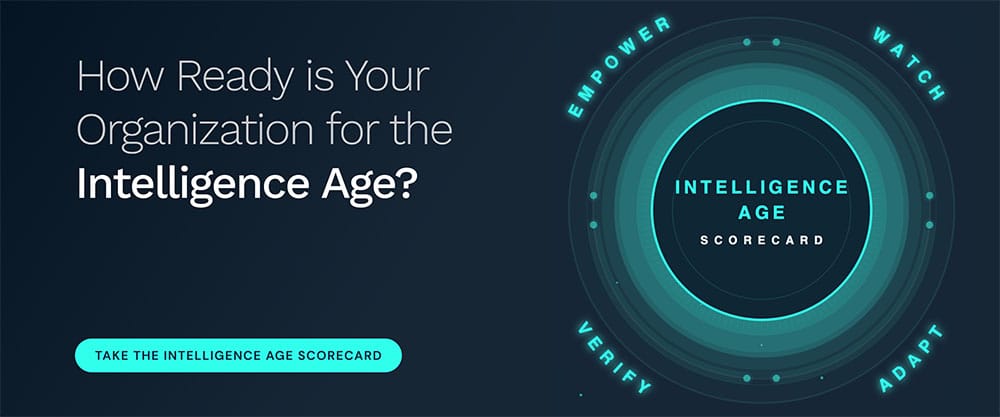
The method of scientific discovery is being rebuilt on AI that a handful of private labs own, from a software company designing its own drugs to a nation treating research compute as sovereignty. That is a WAVE question — Watch, Adapt, Verify, Empower: are you still watching AI reach your R&D, or should you already be adapting how you verify and own what it discovers?
Benchmark your readiness for the next two quarters with the Intelligence Age Scorecard. Or read the public Intelligence Age Scorecard of IBM, Visa, Qantas, Woolworths, Telstra or Commonwealth Bank first.
If this newsletter was forwarded to you, you can sign up here.
Thank you.
Mark
Frequently asked questions
How is AI changing the traditional scientific method?
For four centuries science ran on publishing data, sharing methods, and letting anyone reproduce results. That system is being rewritten because AI is moving from a tool scientists use to the underlying layer discovery runs on. A software company with no laboratory now designs its own medicines, and a national research institute has declared that the method of science itself is being rebuilt, largely on privately owned systems.
Link to this questionWhat is the risk of AI-driven scientific discovery being privately owned?
When the method of discovery becomes a product, reproducibility depends on a vendor's version history: a model updates and the experiment beneath a thousand labs quietly changes. The openness that made science self-correcting starts to sit behind a login and a credit card, meaning whoever owns the discovery layer sets the terms of what gets discovered and who owns it.
Link to this questionWhy does verification matter more than idea generation in AI-driven research?
AI systems generate hypotheses faster than any human can check them, so the scarce resource stops being ideas and becomes verification. Verification is described as the one thing that has not been automated, and may not want to be, making it central to whether results produced by these systems can actually be trusted.
Link to this questionWhat does 'AI sovereignty' mean in the context of scientific research?
AI sovereignty refers to a nation treating research compute and AI-for-science capability as a matter of national control rather than leaving it to private vendors. Japan has paired a new supercomputer with a US research pact to pursue this, understanding that whoever owns the discovery layer sets the terms of what gets discovered and who owns the resulting knowledge.
Link to this question
Dr. Mark van Rijmenam
Dr. Mark van Rijmenam is The Digital Speaker, a world-leading futurist and global AI keynote speaker who helps leaders decide what AI, and the technologies that follow it, mean for their business. He speaks to leadership teams at their retreats and to conference audiences worldwide, and his WAVE framework gives them a way of deciding that they keep using long after he has left the room. His Intelligence Age Scorecard measures how ready an organization is across the four WAVE pillars.
He holds a PhD from the University of Technology Sydney, is a Certified Speaking Professional and Global Speaking Fellow, and ranks among the world’s top futurists on the Global Gurus list (#1 in 2025, #3 in 2026). Salesforce named him one of its 16 leading AI voices. He has written six books, most recently Now What? How to Ride the Tsunami of Change, writes the Synthetic Minds newsletter on Substack, and founded Futurwise. Talk to his digital twin on WhatsApp: +1 (830) 463-6967.