Synthetic Minds | The Robot's Brain Became a Rental It Cannot Yet Feel
Synthetic Minds | The Robot's Brain Became a Rental It Cannot Yet Feel
The Synthetic Minds newsletter offers short daily insights to get you thinking. If you enjoy it, please forward. All signals are powered by Futurwise. If you need more insights, subscribe to Futurwise and get 25% off for the first three months!
I have just launched the Intelligence Age Scorecard! It will help you understand how ready your organization is for the Intelligence Age.
Today’s topic: Spatial Intelligence x Robotics
Who Rents the Mind Inside Your Robots?
A robot brain that can reason about a room, sequence a task, and catch its own mistakes has been placed behind a web address any developer can call. The body that carries out the work has become the easy part to buy.
Read three moves together and the shape of physical AI appears. The intelligence is separating from the machine, and the intelligence is being rented.
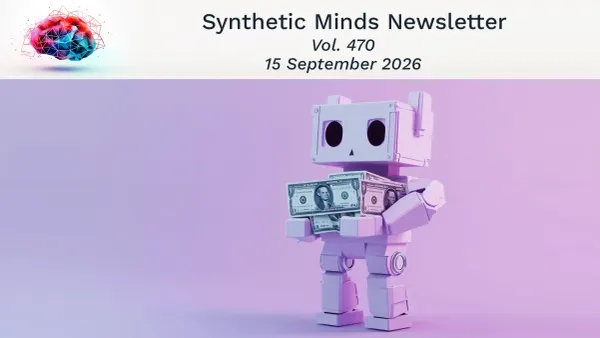
Google's DeepMind has released Gemini Robotics-ER 2, a reasoning model that plans multi-step jobs, tracks its own progress on live video, and coordinates more than one robot at once, delivered through the cloud and commanding bodies from Boston Dynamics and Apptronik.
Fei-Fei Li's World Labs has bought the simulation company SceniX to fold high-fidelity training into its world model, copying a real space into a digital twin, letting robots practice inside it, then pushing the learned behavior back into the physical world.
Then the same lab showed what the eyes miss. A robot that only sees grasps at air; add a sense of touch running ten times faster than vision, and success on delicate tasks climbs significantly.
That's the robotics meets spatial intelligence story. Here is the signal.
The brain and the body of a robot are coming apart, and only one of them is where the power sits.
The reasoning layer, the part that understands a space, orders a task, and knows when it has failed, is becoming a service you rent by the call. The chassis that lifts the box is turning interchangeable.
Whoever owns the brain, and the simulator that trains it, owns the margin, the data, and the roadmap. The company that builds the robot risks ending up as the commodity, the way the handset maker did once the operating system belonged to someone else's cloud. The last time the value moved from the machine to the model, it did not move back.
There is a sharper problem the scoreboards are hiding. The same researchers found models scoring near the top on visual tests while never being shown the image, guessing the answer from the question alone. If the score that certifies a robot's judgment can be earned without perceiving anything, the certificate proves nothing.
And a behavior that worked inside the digital twin is not proof it holds on a real floor, where the friction is wrong and the object slips.
So the board question is not which robot to buy. It is whether the intelligence running your machines is owned or rented, whether you can prove it perceives what it claims to, and who is liable when the simulation was right and the world was not.
The robots are learning to think in the cloud and to feel in the lab. The unsettled question is who owns each half, and which one you will end up merely renting.
The Intelligence Age Scorecard
The reasoning that drives a robot has moved into the cloud, while the sense of touch that makes it reliable is still being invented in a lab. Under the WAVE Framework that is a Verify-and-Empower moment: can you prove the intelligence you depend on perceives what it claims, and do you own enough of it to lead?
Benchmark your readiness for the next two quarters with the Intelligence Age Scorecard. Or read the public Intelligence Age Scorecard of Verizon, Accenture, IBM, Visa, Qantas, Woolworths, Telstra or Commonwealth Bank first.
If this newsletter was forwarded to you, you can sign up here.
Thank you.
Mark
Frequently asked questions
Why is a robot's intelligence being described as rented?
The reasoning layer that lets a robot understand a space, plan a task, and recognize its own mistakes is now delivered through the cloud as a service developers call remotely, rather than built into the machine itself. This means the chassis carrying out physical work has become interchangeable, while the real value and control sit with whoever owns and operates the cloud-based reasoning model.
Link to this questionHow does simulation help train robots?
A simulation company was acquired to build high-fidelity training into a world model, which involves copying a real physical space into a digital twin. Robots can then practice tasks inside that simulated environment before the learned behavior is transferred back into the physical world, though success in the digital twin does not guarantee the same behavior holds on a real floor where friction and conditions differ.
Link to this questionWhy does touch matter for robots that already have vision?
A robot relying only on vision often grasps at air because sight alone cannot capture the fine detail needed for delicate manipulation. Adding a sense of touch that runs ten times faster than vision significantly improves success on delicate tasks, showing that perception combining both senses is necessary for reliable physical performance, not vision alone.
Link to this questionWhat's the risk with benchmark scores for robot judgment?
Researchers found models scoring near the top on visual tests without ever being shown the image, guessing the answer from the question alone. This means a certification claiming a robot perceives and judges correctly can be earned without any actual perception taking place, so such scores may prove nothing about whether the system truly understands what it claims to see.
Link to this question
Dr Mark van Rijmenam
Dr. Mark van Rijmenam, widely known as The Digital Speaker, isn’t just a #1-ranked global futurist; he’s an Architect of Tomorrow who fuses visionary ideas with real-world ROI. As a global keynote speaker, Global Speaking Fellow, recognized Global Guru Futurist, and 5-time author, he ignites Fortune 500 leaders and governments worldwide to harness emerging tech for tangible growth.
Recognized by Salesforce as one of 16 must-know AI influencers , Dr. Mark brings a balanced, optimistic-dystopian edge to his insights—pushing boundaries without losing sight of ethical innovation. From pioneering the use of a digital twin to spearheading his next-gen media platform Futurwise, he doesn’t just talk about AI and the future—he lives it, inspiring audiences to take bold action. You can reach his digital twin via WhatsApp at: +1 (830) 463-6967.