Synthetic Minds | Healthcare Enters the Second Half of the Chessboard
Synthetic Minds | Healthcare Enters the Second Half of the Chessboard
The Synthetic Minds newsletter offers short daily insights to get you thinking. If you enjoy it, please forward. All signals are powered by Futurwise. If you need more insights, subscribe to Futurwise and get 25% off for the first three months!
I built the Intelligence Age Scorecard! It will help you understand how ready your organization is for the Intelligence Age.
Today’s topic: Health
Change is Coming to Healthcare, Fast
Europe has authorized a machine to sign off a normal mammogram with no radiologist reading it. The company behind it, Vara, says more than half of Germany's organized screening program already runs on its software.
Set that beside three unrelated results and a shape appears. The things medicine has always been short of have started to become manufacturable.
Vara has received European certification for autonomous triage, so exams its system judges clearly normal are reported without a radiologist reading them.
Google DeepMind has computed the likely effect of all nine billion single-letter changes the human genome can make, and handed the map out free. A rare-disease team used it to find a variant earlier work had missed, then confirmed it at the bench.
A single injection has built cancer-fighting cells inside sixteen patients in Wuhan, treating multiple sclerosis with no manufacturing facility in the loop.
An engineered pig kidney has held a man off dialysis for 271 days, then failed and was removed, after which a human organ took over cleanly.
And a real-time, electronic health record-integrated machine-learning model running in three emergency rooms was successfully deployed in emergency departments to identify patients with opioid use disorder.
That's the technology story. Here is the signal.
None of this is proof that healthcare has changed. It is proof that change is coming, and we should be prepared.
Look at what each step removes: a radiologist from a mammogram, a manufacturing plant from a cell therapy, a dead donor from a transplant, a bench from the search for a diagnosis.
Each builds on the last, one step at a time, until medicine reaches the second half of the chessboard and the steps stop being steps.
We are not there. We are close enough that pretending otherwise is a choice.
Which is why the answer is not speed. Picture a hospital buying an autonomous reader because a rival did, never checking how it reads the women at its clinics. That is an arms race, not a strategy.
These decisions carry long-term unintended consequences and require our slowest thinking. In most industries a bad rollout costs a quarter. Here it would cost a cancer found late.
Predictions have always arrived before observations. That is not new and it changes nothing.
What changes is the ratio. When the rare-disease team found the variant behind an unexplained epilepsy, they took it to the bench and proved it. That second step is the whole discipline, and it matters more as predictions improve, not less.
The other version is visible. A map of nine billion mutations its makers say is not approved for clinical use. A model scoring 0.99 in the lab that correctly identifies four in ten of the patients who walk into an emergency room.
That distance has been named here before.
Prepare for exponential change. Implement it with your slowest thinking. Those two instructions do not resolve, and in healthcare the gap between them is measured in patients.
The Intelligence Age Scorecard
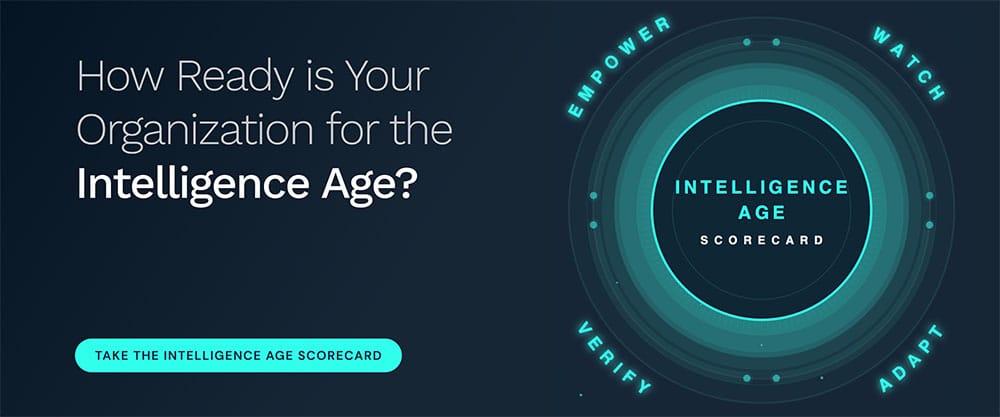
Four of medicine's oldest shortages became manufacturable, and none of it yet proves healthcare has changed. WAVE exists for exactly this gap: are you still watching this converge, or should your organization already be adapting to it?
Benchmark your readiness for the next two quarters, and the next five years, with the Intelligence Age Scorecard.
If this newsletter was forwarded to you, you can sign up here.
Thank you.
Mark
Frequently asked questions
What is Vara's role in mammogram screening in Germany?
Vara has received European certification for autonomous triage, meaning its software can sign off on exams it judges clearly normal without a radiologist reading them. The company says more than half of Germany's organized screening program already runs on its software, illustrating how manufacturable diagnostic capacity has become.
Link to this questionWhat did Google DeepMind's genome mutation map achieve?
Google DeepMind computed the likely effect of all nine billion single-letter changes the human genome can make and released the map for free. A rare-disease team used it to find a genetic variant that earlier work had missed, then confirmed the finding at the bench, though the map's makers say it is not approved for clinical use.
Link to this questionWhy does the article warn against healthcare providers rushing to adopt these technologies?
Because these decisions carry long-term unintended consequences and demand slow, careful thinking rather than speed. Adopting an autonomous reader simply because a rival did, without checking how it performs on your own patients, is described as an arms race rather than a strategy. In healthcare, a bad rollout could mean a cancer found too late rather than just a costly quarter.
Link to this questionWhat other medical breakthroughs are mentioned alongside the mammogram AI?
A single injection built cancer-fighting cells inside sixteen patients in Wuhan to treat multiple sclerosis without any manufacturing facility involved. An engineered pig kidney kept a man off dialysis for 271 days before failing and being replaced by a human organ. Also, a real-time, electronic health record-integrated machine-learning model was deployed in three emergency rooms to identify patients with opioid use disorder.
Link to this question
Dr. Mark van Rijmenam
Dr. Mark van Rijmenam is The Digital Speaker, a world-leading futurist and global AI keynote speaker who helps leaders decide what AI, and the technologies that follow it, mean for their business. He speaks to leadership teams at their retreats and to conference audiences worldwide, and his WAVE framework gives them a way of deciding that they keep using long after he has left the room. His Intelligence Age Scorecard measures how ready an organization is across the four WAVE pillars.
He holds a PhD from the University of Technology Sydney, is a Certified Speaking Professional and Global Speaking Fellow, and ranks among the world’s top futurists on the Global Gurus list (#1 in 2025, #3 in 2026). Salesforce named him one of its 16 leading AI voices. He has written six books, most recently Now What? How to Ride the Tsunami of Change, writes the Synthetic Minds newsletter on Substack, and founded Futurwise. Talk to his digital twin on WhatsApp: +1 (830) 463-6967.