Synthetic Minds | The Money Arrived. The Trust Layer Started Breaking.

Synthetic Minds | The Money Arrived. The Trust Layer Started Breaking.
The Synthetic Minds newsletter offers short daily insights to get you thinking. If you enjoy it, please forward. All signals are powered by Futurwise. If you need more insights, subscribe to Futurwise and get 25% off for the first three months!
I have just launched the Intelligence Age Scorecard! It will help you understand how ready your organization is for the Intelligence Age.
Today’s topic: Tokenization
Who Backstops the Price and the Key of Digital Money?
A sovereign fund running 430 billion dollars has put its private-markets money onto a public blockchain. In the same stretch, an attacker took the master key to a stablecoin and forced an entire network to freeze.
Read those as two headlines and they cancel out. Read them together and a system appears: the money is arriving on rails whose trust layer is breaking under it.
The arrival is real. Abu Dhabi's Mubadala Capital has put a s75-million-dollar private-markets fund on-chain, the illiquid, hard-to-move kind, not a simple bond wrapper.
The firm that builds the plumbing behind BlackRock's on-chain fund has taken the license that lets it advise institutions directly.
A brokerage app has become the top network for tokenized assets by number of holders, more than three hundred thousand of them inside a month.
Then the trust layer gave way. An attacker seized the master key to a stablecoin contract, minted millions from nothing, and forced the network to suspend every bridge it runs.
A second dollar-token lost its dollar because someone fed it a fake Bitcoin price, and it believed the lie in one transaction, with no second opinion.
That's the tokenization story. Here is the signal.
Every tokenized asset rests on two thin wires. One is the price feed that says what your collateral is worth. The other is the key that controls who can issue and who can freeze.
Both are private. Both have broken in the space of days.
This is not a hacking story. It is a story about what a stamp is worth. For centuries the value of a gold coin depended on the assayer who certified its purity. Debase the assayer, and every coin already stamped becomes suspect, backward through time.
The oracle and the issuer key are the assayers of tokenized finance. When one can be forged and the other seized, every position already blessed by that machinery is worth only what the machinery can be trusted to say.
The argument that the financial stack has moved into private hands named who holds the pen at each layer. The sequel writes itself. The two most load-bearing pens are breaking under the weight of the money flowing over them.
Here is the consequence nobody underwrote. Sovereign funds and brokerages have begun routing real capital across a trust surface that is failing faster than audit practice adapts to it, and a single stolen key can freeze an entire network in one transaction.
So the board question has changed. Not whether to tokenize. But who backstops the price and the key when both are privately held, and whether that promise sits in any contract you actually own.
Tokenization has crossed from pilot to portfolio. The unglamorous question decides everything: when the assayer can be bought, what is your stamp worth?
The Intelligence Age Scorecard
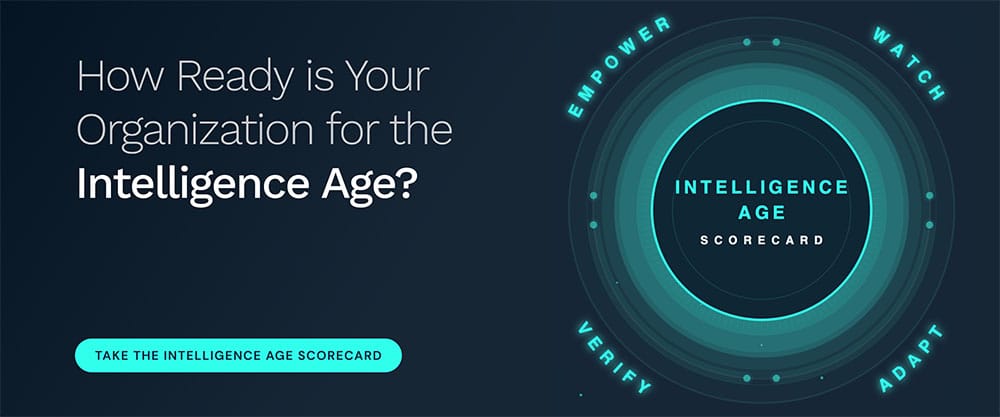
Sovereign capital has moved onto tokenized rails in the same stretch a stolen issuer key froze a network and a forged price feed erased a stablecoin. The WAVE Framework, Watch, Adapt, Verify, Empower, asks which move this demands: are you still watching this shift, or should you already be verifying who backstops the price feed and the keys behind your tokenized exposure?
Benchmark your readiness for the next two quarters with the Intelligence Age Scorecard. Or read the public Intelligence Age Scorecard of Verizon, Accenture, IBM, Visa, Qantas, Woolworths, Telstra or Commonwealth Bank first.
If this newsletter was forwarded to you, you can sign up here.
Thank you.
Mark
Frequently asked questions
What are the two weak points in tokenized finance?
Every tokenized asset rests on two thin, privately controlled wires: the price feed that says what collateral is worth, and the issuer key that controls who can mint and freeze tokens. Both are privately held, and both have failed within days of each other, exposing how fragile the trust layer beneath tokenized assets really is.
Link to this questionWhat happened with the stablecoin attack?
An attacker seized the master key to a stablecoin contract, minted millions of tokens from nothing, and forced the entire network to suspend every bridge it operates. Separately, another dollar-token lost its peg after someone fed it a fake Bitcoin price, which the system accepted in a single transaction with no second opinion or verification check.
Link to this questionWhy does the assayer comparison matter for tokenized assets?
For centuries a gold coin's value depended on the assayer certifying its purity; debase that assayer and every coin already stamped becomes suspect. The oracle and issuer key act as the assayers of tokenized finance. When one can be forged and the other seized, every position already validated by that machinery is only worth what the machinery can be trusted to say.
Link to this questionWhat question should boards be asking about tokenization now?
The question is no longer whether to tokenize assets, since sovereign funds and brokerages are already routing real capital onto these rails. Instead, boards must ask who backstops the price feed and the issuer key when both are privately held, and whether that backstop promise actually sits in a contract the organization owns, rather than assuming it away.
Link to this question
Dr Mark van Rijmenam
Dr. Mark van Rijmenam, widely known as The Digital Speaker, isn’t just a #1-ranked global futurist; he’s an Architect of Tomorrow who fuses visionary ideas with real-world ROI. As a global keynote speaker, Global Speaking Fellow, recognized Global Guru Futurist, and 5-time author, he ignites Fortune 500 leaders and governments worldwide to harness emerging tech for tangible growth.
Recognized by Salesforce as one of 16 must-know AI influencers , Dr. Mark brings a balanced, optimistic-dystopian edge to his insights—pushing boundaries without losing sight of ethical innovation. From pioneering the use of a digital twin to spearheading his next-gen media platform Futurwise, he doesn’t just talk about AI and the future—he lives it, inspiring audiences to take bold action. You can reach his digital twin via WhatsApp at: +1 (830) 463-6967.