Synthetic Minds | Locking the Doors Against a Weapon Nobody Has Built, Yet
Synthetic Minds | Locking the Doors Against a Weapon Nobody Has Built, Yet
The Synthetic Minds newsletter offers short daily insights to get you thinking. If you enjoy it, please forward. All signals are powered by Futurwise. If you need more insights, subscribe to Futurwise and get 25% off for the first three months!
I have just launched the Intelligence Age Scorecard! It will help you understand how ready your organization is for the Intelligence Age.
Today’s topic: Quantum Computing
Your Quantum-Safe Badge Might Prove Nothing
The computer that can crack current encryption has not, yet, been built. A national regulator has still ordered its banks to defend against it, a networking giant has wired the defense into live routers, and a national lab has taken delivery of the hardware.
That is the shift hiding in plain sight: quantum security has stopped being a research topic and become a line item, in compliance, in procurement, in the network itself.
Switzerland's financial regulator has told its banks to inventory their encryption and draft migration maps, after finding most had no plan.
Cisco, with Aliro and zerothird, has fed quantum-generated keys into production routers in an Italian lab, pushing key-by-photon security off the research bench toward a commercial service.
In Germany, QuiX has delivered a room-temperature quantum machine built to sit beside ordinary servers, handed to a national aerospace lab. None of it waits for the code-breaker to arrive.
The urgency has a source. The estimated size of a code-breaking machine keeps shrinking, smaller by orders of magnitude, with AI helping design the attack.
That's the readiness story. Here is the signal.
Every one of these moves treats a hypothetical as a fact. They are right to.
The threat needs no working quantum computer to hurt you. An adversary can copy your encrypted traffic and store it, then crack it years later when the machine exists. Any secret with a long shelf life, health records, defense files, banking data, intellectual property, is already exposed. A migration finished in 2030 cannot protect what has already left the building.
Here is what the readiness headlines miss. The defense being deployed secures the conversation but not the caller. Upgrading how two systems agree on a shared secret is the easy half. Rebuilding the certificates that prove who they are is the hard half, and almost nobody has done it.
Think of a phone call scrambled so perfectly that nobody can listen in. The line is sealed, and you still have no way to prove who picked up on the other end. The conversation is quantum-proof; the caller is not. You can share your deepest secrets, in total privacy, with an impostor.
So an organization can hold a quantum-safe badge while its identity stays forgeable. The certificate certifies less than it claims.
Then there is the data already locked inside your own vaults. Those storage locks barely bend to quantum, the walls are the sturdy part. The trap is that the key to the vault is often kept inside the flimsier lock. Copy the files, hold them, and a later machine cracks the envelope and lifts the key. Long-lived records are exposed the day they are written, not the day quantum arrives.
That is the same trap the assurance problem in AI safety exposed: the test passes, the thing being tested does not hold. A green checkmark is not a secure system.
And a second fork has opened underneath all of it. Some are hardening the math, others betting on keys carried by particles of light. Two standards, one weakest link that defines the exposure of anyone running both.
The question your board should debate is not when quantum breaks your encryption. It is sharper: when you call yourself quantum-safe, what have you actually proven, and who checked?
The Intelligence Age Scorecard
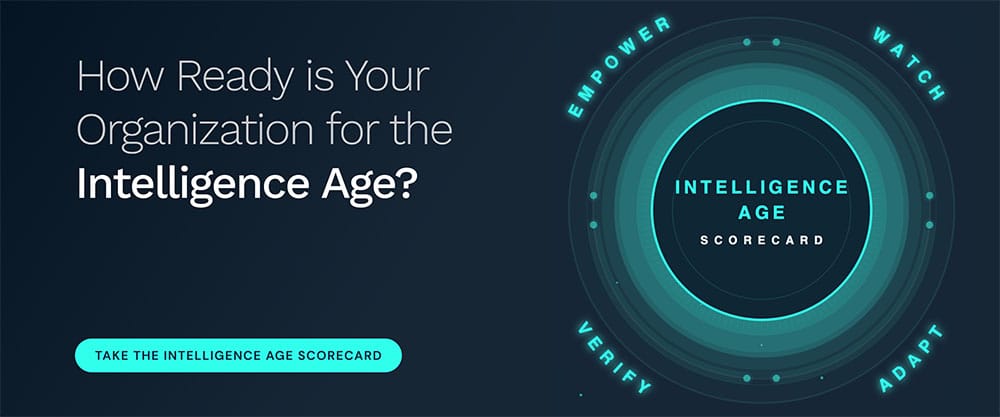
The defense against a quantum code-breaker has moved into banking rules, live routers, and a national lab, before the machine that justifies it exists. That is a Watch-or-Adapt question under the WAVE framework: are you still monitoring quantum as a distant risk, or should you already be inventorying your cryptography and pressure-testing what "quantum-safe" actually proves?
Benchmark your readiness for the next two quarters with the Intelligence Age Scorecard. Or read the public Intelligence Age Scorecard of Accenture, IBM, Visa, Qantas, Woolworths, Telstra or Commonwealth Bank first.
If this newsletter was forwarded to you, you can sign up here.
Thank you.
Mark
Frequently asked questions
Why are organizations preparing for quantum computers that don't exist yet?
An adversary can copy encrypted traffic today and store it, then crack it years later once a working code-breaking machine exists. Any secret with a long shelf life, such as health records, defense files, banking data, or intellectual property, is already exposed. A migration completed later cannot protect data that has already been copied and taken away.
Link to this questionWhat does a quantum-safe badge actually fail to prove?
A quantum-safe badge typically secures the encrypted conversation between two systems but does not rebuild the certificates that prove who those systems actually are. This means an organization can be quantum-safe in how it scrambles data while its identity verification remains forgeable, allowing secrets to be shared in total privacy with an impostor posing as the legitimate party.
Link to this questionWhy is data already stored in vaults still at risk from quantum threats?
Storage locks themselves barely bend to quantum attacks, but the key to the vault is often kept inside a weaker lock. If someone copies the files and holds them, a future quantum machine can crack that weaker envelope and lift the key. This means long-lived records are exposed the day they are written, not the day a working quantum computer arrives.
Link to this questionWhat are the two competing approaches to quantum-safe security?
One approach hardens the mathematical algorithms used in encryption, while the other relies on keys carried by particles of light, such as photon-based quantum key distribution. These represent two separate standards, and running both creates a single weakest link that defines an organization's actual exposure, since strength in one approach does not compensate for weakness in the other.
Link to this question
Dr Mark van Rijmenam
Dr. Mark van Rijmenam, widely known as The Digital Speaker, isn’t just a #1-ranked global futurist; he’s an Architect of Tomorrow who fuses visionary ideas with real-world ROI. As a global keynote speaker, Global Speaking Fellow, recognized Global Guru Futurist, and 5-time author, he ignites Fortune 500 leaders and governments worldwide to harness emerging tech for tangible growth.
Recognized by Salesforce as one of 16 must-know AI influencers , Dr. Mark brings a balanced, optimistic-dystopian edge to his insights—pushing boundaries without losing sight of ethical innovation. From pioneering the use of a digital twin to spearheading his next-gen media platform Futurwise, he doesn’t just talk about AI and the future—he lives it, inspiring audiences to take bold action. You can reach his digital twin via WhatsApp at: +1 (830) 463-6967.