Synthetic Minds | Big Tech Stopped Buying Certificates, Started Buying Reactors
Synthetic Minds | Big Tech Stopped Buying Certificates, Started Buying Reactors
The Synthetic Minds newsletter offers short daily insights to get you thinking. If you enjoy it, please forward. All signals are powered by Futurwise. If you need more insights, subscribe to Futurwise and get 25% off for the first three months!
I have just launched the Intelligence Age Scorecard! It will help you understand how ready your organization is for the Intelligence Age.
Today’s topic: Climate & Energy
Clean-Power Claims Are Shifting From Paper to Proof
Three of the largest computing companies on earth have stopped trusting the certificates that once proved they ran on clean power. They have started signing for reactors instead.
Seen together, a shift appears. Climate accountability is leaving the world of paper, certificates, pledges, annual averages, for the world of physical, contracted, certified proof.
The pressure is physical. Renewable build has fallen behind the electricity that AI data centers demand, and paper claims no longer match what physically flows.
So the buyers have changed what they buy. Every major AI company has signed firm nuclear contracts, including a sixteen-billion-dollar restart of a shuttered plant.
The emissions side is moving the same way. Climeworks has shifted its carbon-removal business from voluntary goodwill toward tonnes certified under regulated frameworks an auditor will accept.
Even the certificate itself is under strain. Microsoft's emissions rose about a quarter after it stopped buying some renewable credits, the paper stopped covering the physical.
Governments are writing the shift into law. Australia has moved to make large data centers put back at least as much clean power as they draw, a mandatory national standard its leaders call the first of its kind.
That's the clean-power story. Here is the signal.
The clean-power promise has always run on paper. A company buys renewable certificates, matches them against a year of use, and calls itself green, even when the power at two in the morning came from gas. That accounting held as long as nobody checked.
AI is checking. Its hunger for round-the-clock power has outrun the clean supply being built, and the distance between the claim on paper and the electron in the wire has become impossible to hide.
The response is a flight to hard proof. The buyers no longer collect certificates; they sign for reactors, and build fuel cells onto their own sites to bypass the grid queue entirely. On the emissions side, the removal market has stopped selling goodwill and started selling certified tonnes a regulator will accept.
This is the shift beneath the headlines: accountability moving from self-attestation to certification, from the certificate to the contract.
It carries a cost few have priced. Certified proof is expensive, and it favors whoever can sign decade-long deals and afford engineered removal. The largest players, and the handful of certifiers and governments that decide what counts as real. The flexible market that let smaller organizations take part is the quiet casualty.
So the question a board should debate is not whether it has offset its emissions. It is whether it can prove every megawatt-hour and every tonne to a regulator, and who owns the rails that decide.
The self-declared green company is ending. What replaces it will be contracted and certified, and owned by whoever controls the proof.
The Intelligence Age Scorecard
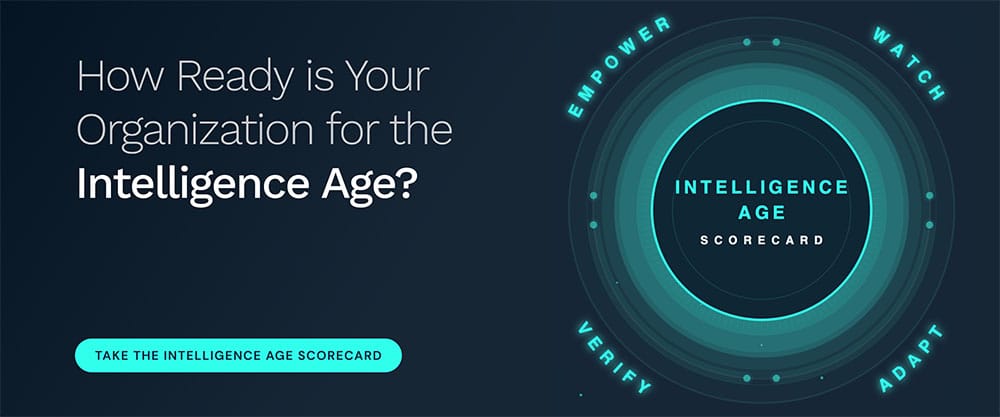
The instruments that certified clean-power progress, renewable certificates, voluntary pledges, annual matching, are hardening into contracted, certified proof as AI demand outruns clean supply. WAVE, Watch, Adapt, Verify, Empower, asks which move this demands of you: are you still watching your certificate count, or should you already be verifying whether your claims survive a regulated audit?
Benchmark your readiness for the next two quarters with the Intelligence Age Scorecard. Or read the public Intelligence Age Scorecard of Verizon, Accenture, IBM, Visa, Qantas, Woolworths, Telstra or Commonwealth Bank first.
If this newsletter was forwarded to you, you can sign up here.
Thank you.
Mark
Frequently asked questions
Why are big tech companies moving away from renewable energy certificates?
Renewable certificates let companies claim clean power by matching purchases against a year of usage, even if actual power at a given moment came from gas. AI data centers now demand round-the-clock electricity that has outrun clean supply, making the gap between paper claims and actual electrons flowing impossible to hide. This has pushed companies toward physical, contracted proof instead of paper accounting.},{
Link to this questionWhat is replacing traditional clean-power certificates?
Major AI companies are signing firm nuclear contracts, including a sixteen-billion-dollar restart of a shuttered plant, and building fuel cells on their own sites to bypass the grid queue. On the emissions side, carbon-removal companies like Climeworks are shifting from voluntary goodwill claims toward tonnes certified under regulated frameworks that auditors will accept, moving accountability from self-attestation to certification.
Link to this questionWhat happened to Microsoft's emissions after it stopped buying renewable credits?
Microsoft's emissions rose about a quarter after it stopped purchasing some renewable credits, revealing that the paper certificates had stopped covering the actual physical power being used. This exposed the gap between certificate-based claims and the real electricity flowing into operations, reinforcing the broader shift toward verified, physical proof of clean energy use.
Link to this questionWhat is the downside of the shift to certified clean-power proof?
Certified proof is expensive and favors organizations that can sign decade-long contracts and afford engineered carbon removal, meaning the largest players and the certifiers and governments deciding what counts as real gain the most power. The flexible market that once allowed smaller organizations to participate in clean-power claims becomes a quiet casualty of this shift toward rigorous, contracted certification.
Link to this question
Dr Mark van Rijmenam
Dr. Mark van Rijmenam, widely known as The Digital Speaker, isn’t just a #1-ranked global futurist; he’s an Architect of Tomorrow who fuses visionary ideas with real-world ROI. As a global keynote speaker, Global Speaking Fellow, recognized Global Guru Futurist, and 5-time author, he ignites Fortune 500 leaders and governments worldwide to harness emerging tech for tangible growth.
Recognized by Salesforce as one of 16 must-know AI influencers , Dr. Mark brings a balanced, optimistic-dystopian edge to his insights—pushing boundaries without losing sight of ethical innovation. From pioneering the use of a digital twin to spearheading his next-gen media platform Futurwise, he doesn’t just talk about AI and the future—he lives it, inspiring audiences to take bold action. You can reach his digital twin via WhatsApp at: +1 (830) 463-6967.